|
In this Newsletter:
- Forthcoming VSM-General Webinars
- Announcement VSM Practitioner webinars Oct-Dec 2026
- News from Stafford's centenary
|
| |
|
Forthcoming General Webinars
7 October, 2026. Ian Kendrick. Metaphorum’s The People’s Emergency Briefing webinar
4 November, 2026. Marc-André Pigeon. Beer’s Pedagogy: Lessons from the Concordia University Lectures. Beer’s Pedagogy: Lessons from the Concordia University Lectures.
2 December, 2026. Martin Pfiffner. From Theory to Practice, and Back.
TO REGISTER FOR THE GENERAL WEBINARS
Go to https://metaphorum.org/upcoming-webinars and click PARTICIPATE. Ticket Tailor will register you and send a webinar link by email
|
| |
|
Forthcoming VSM-Practitioner Webinars
14 October, 2026. Andreas Schmidt, VR Bank Starnberg on an Application Case. This webinar will be given in German.
11 November, 2026. Mark Lambertz, 'Learning and using the Viable System Model with gamified approaches'.
|
| |
|
Metaphorum’s The People’s Emergency Briefing webinar
Ian Kendrick
Last November a session with representatives from the UK government took place in London. Referred to as The National Emergency Briefing it addressed the complexity, severity and urgency of the crucial issues created by the global climate crisis.
Focused on the UK at this stage, the briefing covered aspects including the effect of the crisis on our: Health, Health systems, Food security, National security, Economics, and Energy transition. Each of these matters was described in some detail by an expert in the specific field being addressed, using data deemed to be reliable and relevant. The group is chaired by Mike Berners-Lee, brother of Tim.
Out of this work emerged The People’s Emergency Briefing. It covers the same ground as the National Emergency Briefing, this time aimed at members of the public. This briefing is in the form of a 50 minute video with each section commented on by members of the public and celebrities giving their views. The video is introduced by Chris Packham.
There are several objectives of the organisers of the Public Emergency Briefing video: Introduce the public to the scale and urgency of addressing the climate crisis; and Campaign the government to generate their own broadcast about the climate crisis and how they are, or will, address it.
The webinar on the 7th October will be facilitated by Ian Kendrick who will briefly introduce the video and facilitate dialogue after it. The idea here is, as a group of cyberneticians, to discuss how we might work together to help this rapidly growing movement using our insights and approaches. The timing has some significance being shortly after Metaphorum’s 100 year celebration of Stafford’s work. The time has come.
|
| |
|
Ian Kendrick
Ian has spent more than 50 years working in different disciplines including strategy, communications, crisis management. In the mid 1990s he was introduced to Stafford’s work and was angry that he did not know of it sooner and its lack of presence in our education system, at all levels. Since that time, Ian has used the VSM and other systemic approaches in his work. This includes Three Horizons, Ian was a co-founder of H3Uni and uses 3H and the VSM in combination with concepts of transformation. Currently he is working with the International Evaluation Academy to help them configure their global field to be better able to address the polycrisis we all face.
As a father and grandfather Ian’s motivation comes from Jonas Salk’s important question – “Am I being a good ancestor?”.
|
| |
|
Beer’s Pedagogy: Lessons from the Concordia University Lectures
Marc-André Pigeon.
November the 4th, 2026
Stafford Beer’s writings have been widely recognized as novel, erudite, profound and influential, shaping decades of contributions from scholars and practitioners alike. They have also been criticized as opaque and difficult to apply, contributing to a tendency for his work to exist on the margins of mainstream academia and management. Beer was sensitive to these critiques. By his own account, he penned Diagnosing the System in part to address these concerns. In it, he provides a step-by-step stripped-down approach to understanding and deploying the viable systems model (VSM) for managers and others interested in how the analytical tool could help with real-world decision-making. In the forward to Diagnosing the System, Beer says the book was inspired and shaped by his experienced co-teaching the VSM in a seminar course offered at Concordia, Montreal, Canada, in 1981-82. He devotes the book to the students of this class, insisting that the book resulted from “my learning.” My contribution will share reflections on what we can learn from Stafford Beer’s approach to pedagogy by analyzing recently digitalized recordings of these lectures. My method is interpretative and is inspired by a second-order cybernetics perspective of a ‘model of the modeler,’ paying close attention to Beer’s pedagogical approach and indications of self-awareness about his pedagogical style. I expect that this analysis will help us understand how we might learn from Beer’s pedagogy and better communicate and teach about the VSM. It will also shed some light on Beer’s time in Canada, a place he would eventually call home until his passing in 2002 and which figured prominently in Diagnosing the System and in other of his later works.
|
| |
|
Marc Andre Pigeon

Marc-André Pigeon is the director of the Canadian Centre for the Study of Co-operatives and an assistant professor in the Johnson Shoyama Graduate School of Public Policy (JSGS). His research interests center around the study of co-operatives, governance, and money and banking. In relation to this line of inquiry, Dr. Pigeon has of late been exploring the intersection of cybernetics, co-operative governance and public policy. Prior to joining the JSGS, Dr. Pigeon worked as the assistant vice president of financial sector policy at the Canadian Credit Union Association, where he was responsible for monitoring, researching and advocating on behalf of credit unions. He has also served as an advisor at the Department of Finance, a lead analyst for two major Parliamentary committees (Senate Banking, Trade and Commerce; House of Commons Finance), an economist at the Levy Economics Institute, and a business reporter for Bloomberg Business News. Dr. Pigeon holds a PhD from Carleton University in mass communications, a master’s degree in economics from the University of Ottawa, and a journalism degree from Carleton University. Dr. Pigeon has served on several non-profit and charitable boards, including the Co-operative Development Foundation (CDF), the Saskatchewan Co-operative Association, and Saskatoon Unitarians. In his spare time, he enjoys all-season camping with his family and their dog Pepsi and volunteering as a mechanic at Bridge City Bicycle Co-operative. |
| |
|
From Theory to Practice, and back
Martin Pfiffner
December the 2nd, 2026
This talk summarises Martin's Festschrift Chapter, which reflects on more than three decades of practical experience with Stafford Beer’s management cybernetics, in particular the Viable System Model (VSM), Team Syntegrity (TS), and the concept of the Operations Room. Drawing on applications across corporations, public institutions and NGOs, it traces a journey from theoretical understanding to practical implementation - and back again to conceptual clarification.
While Beer’s work provides a rigorous cybernetic model for diagnosing and designing organisational viability, its practical application remains insufficiently elaborated and operationalised. Drawing on a series of case-based reflections, this paper demonstrates how Beer’s legacy can yield substantial results when applied with due regard to contextual complexity and requisite variety. At the same time, it highlights the persistent challenges involved in translating cybernetic principles into viable, repeatable, and actionable management practices.
A central argument of the paper relates to the essence of the VSM. A shift in perspective leads to a reinterpretation of the model: rather than an alternative organisational structure (anatomy) or another process-framework (physiology), the VSM is understood as the “neurology” of the organisation - its system of decision and communication that integrates structure and process into a functioning whole. As organisations face increasing complexity and the transformative impact of artificial intelligence, the design of effective decision structures emerges as a critical capability for the future. Despite the evident need, the VSM today offers a powerful account of organisational neurology yet falls short of an equivalent clinical practice. This paper therefore calls for a stronger focus on operationalisation, methodological refinement, and shared learning across contexts.
|
| |
|
Martin Pfiffner
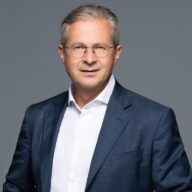
Dr. oec. HSG Martin Pfiffner is a renowned expert on organizational and structural issues. He studied at the University of St. Gallen HSG, where he graduated with a doctorate in economics. As an assistant to Professors Peter Groß (Sociology) and Fredmund Malik (Management), he worked his way into system-oriented management theory. Later he studied management cybernetics in Canada and Wales with Professor Stafford Beer.
For over 30 years he has worked as a lecturer, trainer and consultant for organizations in the business and non-business sector. In various institutions and functions he contributes to the application of the models and methods of management cybernetics such as the “Viable System Model” or “Syntegration®” for the success of companies.
Pfiffner is considered one of the world’s leading experts in the practical application of the Viable System Model and Syntegration®. In the last three decades, Martin has supported countless economic, public or private organizations in all corners of the world. The basis for his work is “The Neurology of Business”. This is what he calls the neurology of an organization and this is also the title of his book.
|
| |
|
Andreas Schmidt
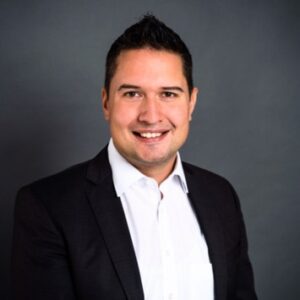
Prokura u. Bereichsleitung Unternehmenssteuerung, VR Bank Starnberg-Zugspitze eG
Andreas begann vor 20 Jahren seine Berufslaufbahn im genossenschaftlichen Bankwesen. Als Schwerpunkt begleitete ihn die Steuerung vom klassischen Controlling bis General Management. Außerhalb seiner Führungsaufgabe ist er als Dozent, Fachautor und Prüfer aktiv. Neben umfänglichen bankfachlichen Qualifikationen weckten seine besondere Neugier die Arbeiten von Prof. Dr. Fredmund Malik zum systemisch-kybernetischen Managementverständnis, einschließlich des VSM.
Er unterstützt den gemeinnützigen Verein Metality e.V., der sich u.a. in der Inklusion, Obdachlosenhilfe und Depressionsunterstützung engagiert.
|
| |
|
Mark Lambertz
Organisational Designer, VSM Coach at BOSCH
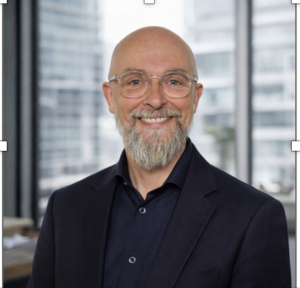
Mark Lambertz is an organisational designer, author and speaker with two decades of experience running a digital agency he co-founded. His work spans reshaping established organisations and designing new organisational structures. Drawing on management cybernetics and the Viable System Model, he translates systems thinking into practical choices about how people collaborate, make decisions and adapt to change.
In his own time, Mark loves to spend time in nature, be it at the lake in Finland or hiking anywhere in the world. |
| |
Stafford Beer 100 — Post-conference news
For those attendees to our centenary conference in Manchester, Juliana Alves has set up a system to obtain your attendance certificates.
Please follow this link, include your name, and the system will provide you with your certificate:
https://certificate.festschrift.beer/
Anyone requesting receipts for payment of conference fees, please request them directly to us - metaphorum.org@gmail.com
We are currently processing:
- the recordings of the talks in the conference (those we managed to record with acceptable quality) and will upload them at the Metaphorum Youtube channel. We will announce it when they are ready to see.
- the Conference Proceedings. we have requested the speakers to share their presentations with us (if they wish to) to include them in the Proceedings - which will be an e-book. We have now 70% of the presentations; once we hear from the missing speakers we will produce the proceedings and announce them here.
- launching our new journal "organisationl Systems' and inviting papers from anyone interested (free of charge for publication and for downloading papers)
The conference WhatsApp community is still very active. We hope to support it with a more adequate communication platform; we will announce it as soon as we have agree on a suitable one.
Anyone interested in leading a "Special Interest Group', - a research community in any of the topic emerging from the conference, please let us know. we will provide you with tools to meet, collect and share information, and we will inivte you to organise webinar in your research topic, when you feel ready for it.
Finally, this is a reminder that our special issues are open for submission of papers from all the centenary events and collaboration with other organisations (e.g., ASC, WOSC, IFSR, CSS, ORS). Please follow these links to explore the special issues and prepare your submissions.
Systems Research and Behavioural Science
Systems Practice and Action Research
|
| |
|